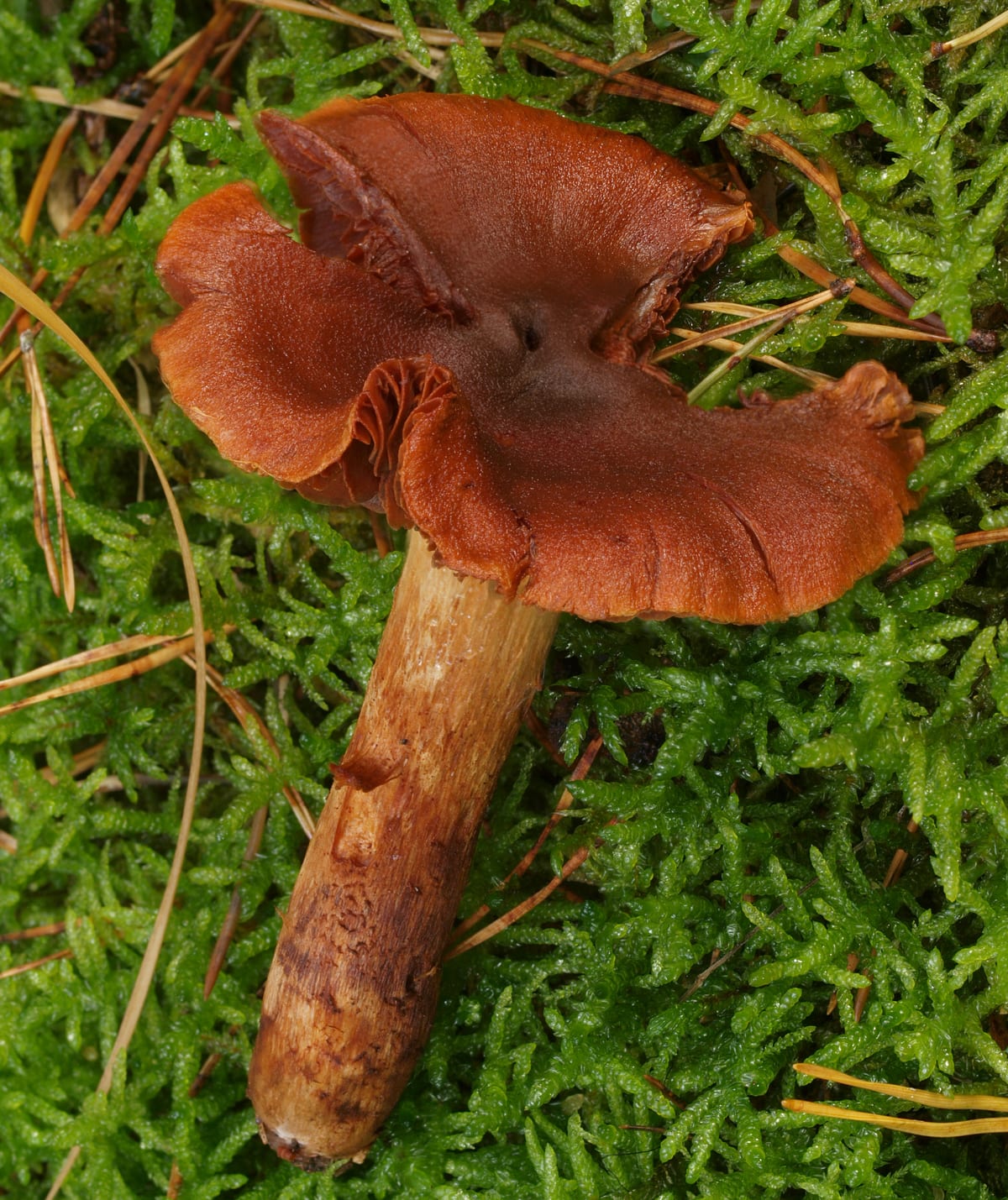
Identification
A small mushroom with a reddish-orange cap and stem and rusty gills. Young Cortinarius species carry a cobwebby cortina veil and a rusty spore print. The species became notorious after a mass poisoning in Poland in the 1950s (135 cases in 1953–1962).
Why it is dangerous
The toxin is orellanine, which selectively destroys the proximal tubules of the kidneys. A literature review (Toxicon, 2001) describes the typical course:
- latent period from 2 days to 3 weeks;
- a pre-renal phase after a few days (median ~3 days): thirst, weakness, lumbar pain;
- renal phase with delay (median ~8.5 days);
- in about half the patients acute kidney failure becomes chronic; of those ~70 % need dialysis or a transplant.
Practical takeaway: kidney failure 1–2 weeks after eating mushrooms is a reason to recall the webcap, even if nothing happened right away.
In practice
- Do not pick small rusty-orange gilled mushrooms with a cobwebby veil.
- Any suspected webcap poisoning — urgently to a nephrologist or toxicologist; tell them exactly which mushrooms were eaten.