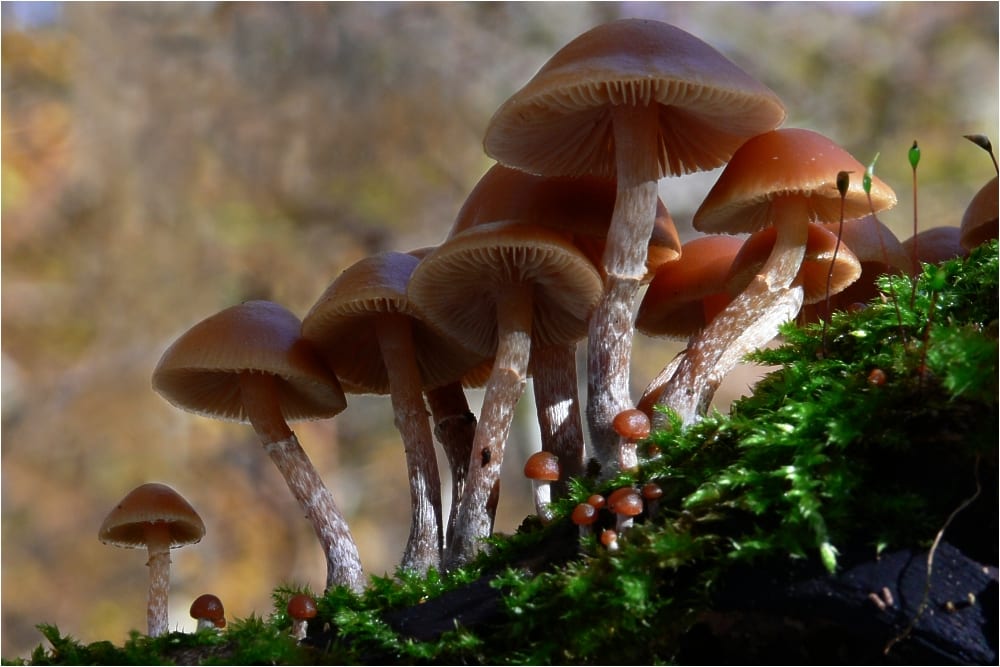
Why it matters if you pick honey fungi
Galerina marginata is a small brownish mushroom on decaying wood. This is not "just another poisonous species": amatoxins have been found in it at concentrations comparable to the death cap. It grows on the same stumps, in the same season, as the autumn honey fungus (Armillaria mellea), and is gathered the same way — a basketful off a stump.
What research shows
- Analysis of 70 Galerina and related samples (PLOS One, 2021): amatoxins found only in the G. marginata s.l. complex; absent from other clades. So "all galerinas are deadly" is false — but safe and dangerous species cannot be told apart by eye: the genus has ~300 species and morphology is tricky.
- Toxins are heat-stable (Beaty Museum): boiling and frying do not help.
- Clinically: onset 6–10 h (nausea, vomiting, diarrhea), transaminases rise around 36 h, liver failure ~72 h after the meal.
- A documented case (Toxicon): three people poisoned, two died; the one who sought help immediately survived, the others arrived 2–3 days later. Toxin content differed even between fruit bodies from the same stump.
How not to confuse with honey fungi
| Feature | Autumn honey fungus | Funeral bell |
|---|---|---|
| Ring on stem | membranous, clearly visible | thin, often disappears quickly |
| Cap | pale honey, with scales | smooth, honey → ochre, striate when drying |
| Spore print | white | rusty brown |
| Flesh | firm, pleasant smell | weak, mealy odor |
Rule: any small brown mushroom on wood without a clearly visible honey-fungus ring is skipped.